Posts: 4,528
Threads: 147
Likes Received: 3,066 in 1,819 posts
Likes Given: 4,215
Joined: Apr 2019
Location Isle of Man
Different frequencies give different drive/brake feel.
Life is like a box of Slot cars...


 •
Posts: 334
Threads: 25
Likes Received: 596 in 255 posts
Likes Given: 143
Joined: Oct 2023
(14th-Aug-25, 02:16 PM)Kevan Wrote: Different frequencies give different drive/brake feel.
Any further insights?
How does drive ‘feel’ change as PWM frequency increases?
Similarly how does brake ‘feel’ change as PWM frequency increases?
Do you see either as significant in what I am attempting to achieve with brushless motors? all insights welcome.
c
•
Posts: 4,528
Threads: 147
Likes Received: 3,066 in 1,819 posts
Likes Given: 4,215
Joined: Apr 2019
Location Isle of Man
I used to have a Novak programmable ESC and you could change the frequencies which had noticeable benefits depending whether you were racing onroad or offroad cars.
This from Hobbywing website:
Lower frequencies (4K-8K) create a punchy feel but generate more heat. Higher frequencies (12K-16K) provide smooth operation and run cooler.
Life is like a box of Slot cars...
•
Posts: 334
Threads: 25
Likes Received: 596 in 255 posts
Likes Given: 143
Joined: Oct 2023
(15th-Aug-25, 08:20 AM)Kevan Wrote: I used to have a Novak programmable ESC and you could change the frequencies which had noticeable benefits depending whether you were racing onroad or offroad cars.
This from Hobbywing website:
Lower frequencies (4K-8K) create a punchy feel but generate more heat. Higher frequencies (12K-16K) provide smooth operation and run cooler.
Thanks Kevan, that’s very helpful.
The Texas Instruments IC I am using requires a motor PWM signal in the range 15kHz to 100kHz, so in due course it will be interesting to learn whether the trend you are describing extends to higher frequencies for the types of motor I am using. I plan to start with 15.7kHz (16MHz chip oscillator divided by 4 then divided by 255)
Also, I read that heat due to MOSFET switching increases as frequency increases. So it may be, as per your reference, that motors run cooler but the electronics runs warmer as frequency increases? Let’s see.
These of course are all second order effects to be explored if the first order effects are proven successful … i.e. if we can show that sensored brushless motors are a viable option for digital slot car racing.
Next, it’s time to fit these motors and matching drive modules into some NSR chassis that are patiently waiting for fit-out :)
c
(This post was last modified: 15th-Aug-25, 10:05 AM by
Dr_C2.)
•
Posts: 4,528
Threads: 147
Likes Received: 3,066 in 1,819 posts
Likes Given: 4,215
Joined: Apr 2019
Location Isle of Man
I should imagine a Slot car motor would need much higher frequencies as it's rotating much faster than a 540 sized RC car motor.
Life is like a box of Slot cars...
•
Posts: 334
Threads: 25
Likes Received: 596 in 255 posts
Likes Given: 143
Joined: Oct 2023
I took a closer look at the R/C Electronic Speed Controller (ESC) which is normally paired with the type of brushless motors I have selected for this project. Yes, its PWM frequencies (both for motor and brake) can be adjusted using a plug-in programming card. For motor PWM it can be adjusted from 2kHz to 48kHz, with a default setting of 8kHz.
My starting point for the newly designed driver modules is 16.7kHz, but I could switch to 33.4kHz (x2) or 66.8kHz (x4) if found to be preferrable.
At this early stage of development I would be happy with anything that is drivable and demonstrates potential :)
Thanks for sharing earlier insights which can only serve to make the final result better!
c
(This post was last modified: 15th-Aug-25, 01:28 PM by
Dr_C2.)
Posts: 334
Threads: 25
Likes Received: 596 in 255 posts
Likes Given: 143
Joined: Oct 2023
I have now built up four prototype brushless motor driver modules which can be piggy-backed onto sensored brushless motors.
So the next step is to demonstrate these modules can be attached to NSR Formula 22 cars and NSR AMG GT3 angle winder cars. This will be done next :)
These driver modules require decoders with PWM signals at >15kHz PMW. This is work in progress for both formula 22 and GT3 decoders and will use the new ‘decoder pro’ firmware which is under development. More on this to follow…
In addition, I have hardware driver modules which include microcontrollers to convert control signals to the required >15kHz PWM. These are also exciting and, all being well, these should function with existing SSD decoders, ICP reflashed decoders, SCX decoders, D132 decoders and, very importantly, oXigen decoders. So all is progressing to plan.
Will sensored brushless motors provide value to the world of digital slot cars? … this is a very big question … so let’s see ;)
c
(This post was last modified: 31st-Aug-25, 08:23 PM by
Dr_C2.)
Posts: 59
Threads: 6
Likes Received: 79 in 38 posts
Likes Given: 74
Joined: Nov 2023
@Dr_C
Yes I think brushless will provide value to digital slot cars, they already do in 1/24 scale analog.
It may take a while but i'm confident it will also happen for 1/32 scale, particularly sensored brushless with digital slotcars.
Posts: 334
Threads: 25
Likes Received: 596 in 255 posts
Likes Given: 143
Joined: Oct 2023
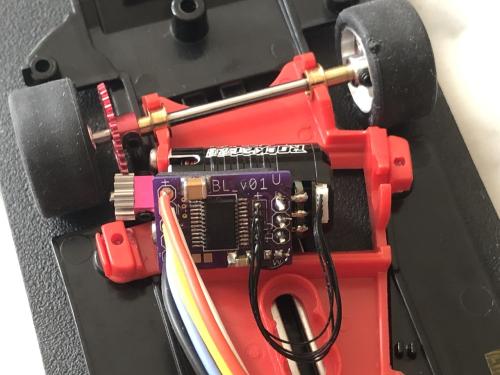
One of the SENSORED brushless motors with piggy-backed driver board. This motor/driver combo powers up with full rpm range plus braking.
The driver board has five wires which connect to the decoder, ground, DC volts, motor PWM, brake and a tacho signal.
The five narrow gauge wires are for power to, and signals from, the three Hall sensors which are internal to the motor and measure the motor’s rotational position.
As mentioned earlier, these driver boards require a decoder PWM signal at >15kHz so the next step is to write decoder firmware which outputs a suitable PWM signal.
c
(This post was last modified: 12th-Sep-25, 03:11 PM by
Dr_C2.)
•
Posts: 334
Threads: 25
Likes Received: 596 in 255 posts
Likes Given: 143
Joined: Oct 2023
The installation is already showing some advantages of sensored brushless motors over standard brushed motors:
1/ the absence of a mechanical commutator avoids motor sparking and hence no requirement for noise suppression at the motor terminals … in short no ‘ferrite man’ or capacitor network required.
2/ the driver board includes a tacho output signal so where an rpm read-out is desired there is no need to add a separate rotation sensor. In the past I have used a small magnet within the road wheel and a static Hall sensor IC to detect each rotation of the wheel. None of this additional hardware is required when using a SENSORED brushless motor.
3/ When running at full rpm (unloaded) the current draw is a fraction of what a similar rpm King Evo brushed motor dissipates. That corresponds to far less unwanted heat dissipation. Precise numerical figures to follow in due course.
4/ The motor runs super smoothly at max rpm. Very little vibration.
Hopefully more advantages to follow…
c
(This post was last modified: 13th-Sep-25, 11:37 AM by
Dr_C2.)


