

30th-Nov-23, 10:12 AM
Next let’s take a look at the tools and workbench setup required for decoder repairs. I am sure others will have different options and methods. So what follows is my approach. 
TOOLS AND WORKBENCH
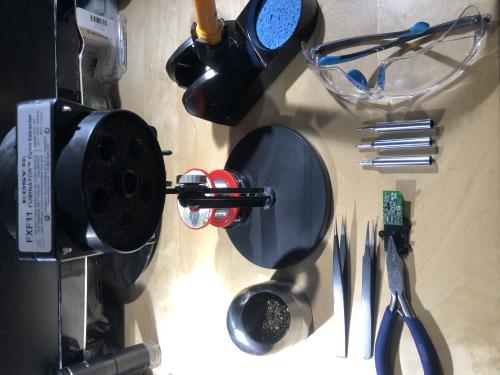
Please click on the photo for high res image which even has the correct orientation :)
Items by clockwise rotation starting at the top.
1/ Filtered fume extractor fan
2/ Electronics grade solder
3/ Soldering iron (mine is an Antex XS 25W) plus heat-proof holder.
4/ Safety glasses
5/ A fine tipped soldering bit (the ‘pointy’ fine-tipped version works well for this type of repair)
6/ the decoder plus a mounting jig. I use the plastic DPR hatch. Remember always rotate the work-piece for the most convenient access. Often tweezers in one hand and soldering iron in the other.
7/ Tweezers - note the tips - one is narrow and sharp and the other is specially shaped to hold parts without risk of scratching. I use both types.
8/ A solder tip cleaner (copper coiled wire). Use this to clean the tip every time you remove the soldering iron from its holder - unusable old solder (dull appearance) gradually builds up on the tip and so the tip requires regular cleaning.
One thing I don’t show is a heat-proof surface to protect the worktop. There are some nice silicone options.
THE CHALLENGE
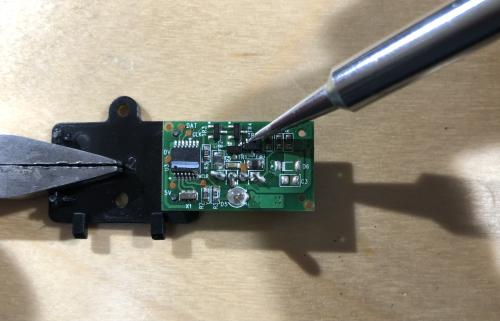
Finally, if we are to attempt decoder repairs we need to be confident we can handle a very hot soldering iron with careful precision and without burning fingers etc! Photo shows the scale of the challenge.
TOOLS AND WORKBENCH
Please click on the photo for high res image which even has the correct orientation :)
Items by clockwise rotation starting at the top.
1/ Filtered fume extractor fan
2/ Electronics grade solder
3/ Soldering iron (mine is an Antex XS 25W) plus heat-proof holder.
4/ Safety glasses
5/ A fine tipped soldering bit (the ‘pointy’ fine-tipped version works well for this type of repair)
6/ the decoder plus a mounting jig. I use the plastic DPR hatch. Remember always rotate the work-piece for the most convenient access. Often tweezers in one hand and soldering iron in the other.
7/ Tweezers - note the tips - one is narrow and sharp and the other is specially shaped to hold parts without risk of scratching. I use both types.
8/ A solder tip cleaner (copper coiled wire). Use this to clean the tip every time you remove the soldering iron from its holder - unusable old solder (dull appearance) gradually builds up on the tip and so the tip requires regular cleaning.
One thing I don’t show is a heat-proof surface to protect the worktop. There are some nice silicone options.
THE CHALLENGE
Finally, if we are to attempt decoder repairs we need to be confident we can handle a very hot soldering iron with careful precision and without burning fingers etc! Photo shows the scale of the challenge.
