


-
Newbie
Forum: Introduce Yourself
Last Post: JasonB -
Manx Slot Car Club - 2026...
Forum: Manx Slot Car Club
Last Post: Kevan -
ModeL Railway #2 begins -...
Forum: Model Railways
Last Post: Savage GT -
1/24 Cars Bought In 2026
Forum: 1:24, 1:25 & 1:28 Scale
Last Post: DPJ -
Slot Wagen NASCAR Truck k...
Forum: 1:32 Scale
Last Post: Savage GT
- Forum posts: 48,449
- Forum threads: 5,010
- Members: 1,694
- Latest member: DutchKing 66
Upcoming Events
WHO Autumn Stages - 28th-Oct-26
WHO Nascar - 4th-Nov-26
NSCC Leatherhead Swapmeet - 8th-Nov-26 ( - {4})
WHO Tin Top Saturday - 14th-Nov-26
WHO Test & Fun Night - 18th-Nov-26
WHO F1 - 2nd-Dec-26
WHO Tin Top Saturday - 12th-Dec-26
Swindon Swapmeet - 10th-Jan-27

The first UK slot car show of 2020 is the Swindon Scalextric Swapmeet on Sunday 5 January.
Organised in conjunction with the Four Lane Blacktop club, the show features a sports hall packed with over sixty traders and various tracks.
The swapmeet takes place at the Oasis Leisure Centre, North Star Avenue, Swindon SW2 1EP.
Doors open at 10.30am. Entry is £2.50 - under-16s get in free.
More details at: www.facebook.com/SwindonScalextric


Looking at grabbing seven of these F1's to add into the racing class in 2020. Can anyone offer any more information on handling, tweaking etc. for the Nonnoslot F1 cars, if there is anyone out there that has heard of these cars.
From what I have been told they run very nice on routed tracks, yes they are a bit pricey but when compared to the price points of NSR and Slot.It, even some Scalextric they really aren't that expensive, even when exchange rates are involved.
The chassis's are stainless steel, all cars are entirely hand built by Marco himself. The reason I am looking at these cars is they are simply much more robust than what is available out there for track racing, they are not those delicate ptels like Scalextric etc. cars.
Nonnoslot website: Nonno Slot Cars or htttp://www.nonnoslot.it/index.php)
Johnno

Here in Japan the slot car racing scene does not appear to be as big as in other countries. A reason for this could be the real estate you need in your home to set up a track. You need a lot of space! Because the market is not so big, there are not a great deal of places to buy the track or the cars, and both have a price premium due to their limited imports. Because of this I am always looking at alternatives...
Enter a Japanese company called Banpro. They make wooden tracks on a large scale, some of which you can find in the Japanese toy store chain Hakuhinkan. Recently in these stores besides the major brand names for slot cars, a cheaper version has appeared with the stores own name on them.
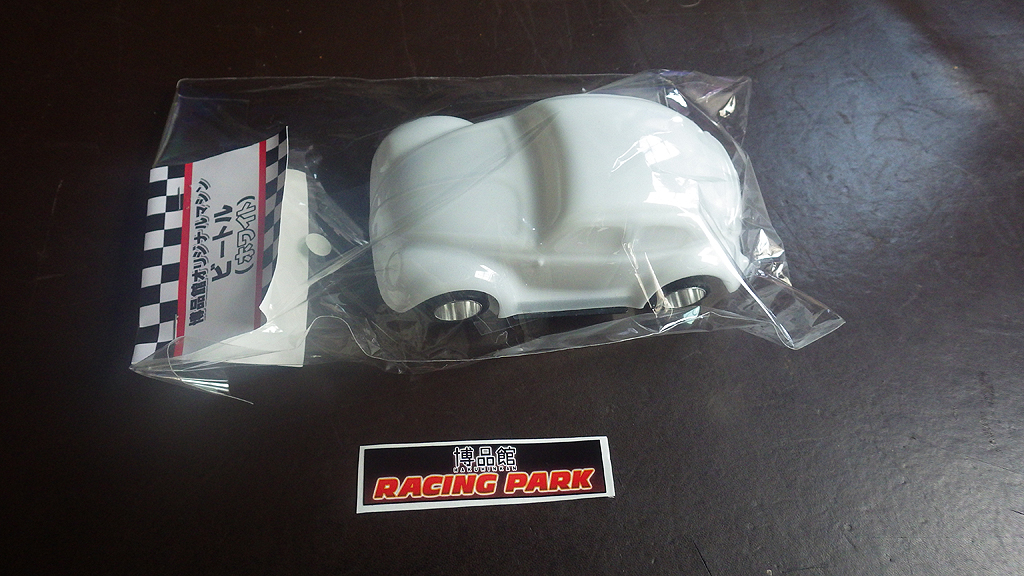
The cars come in a various colours, and at the time of writing, two body styles - Volkswagen Beetle and Mini Cooper.
The cars have a metal adjustable chassis and a durable vacuum formed body.

Slot car racers may see a similarity here for this chassis and that of the Plafit range of chassis parts. There is a good reason for that, Banpro and Plafit are one and the same company, with Banpro focus being custom built tracks and Plafit being high quality chassis parts.
Banpro Online Shop
This cheaper car does not offer all the bells and whistles of the main Plafit line, but it does give you some flexibility.

For racing the car can be made very easy to drive with the 4 round adjustable magnets. You can change the height on these to adjust how strongly the car will hold to the track. Be careful and ensure on plastic tracks with raised rails such as Scalextric and Carrera that these do not actually touch the track.
You can also adjust the wheelbase from around 60mm, right up to 80mm, giving you a good variety of body styles this can be adapted for.
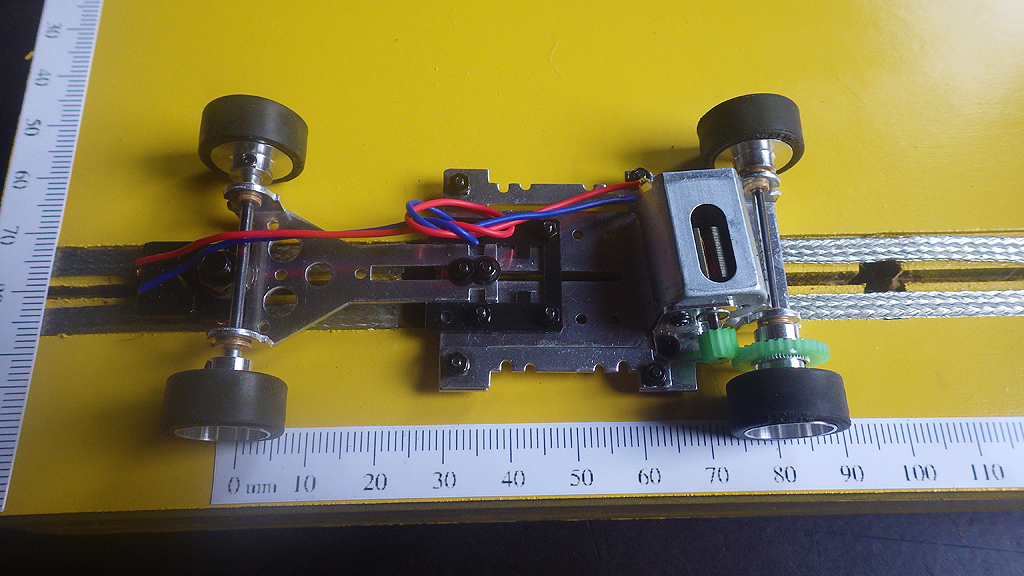
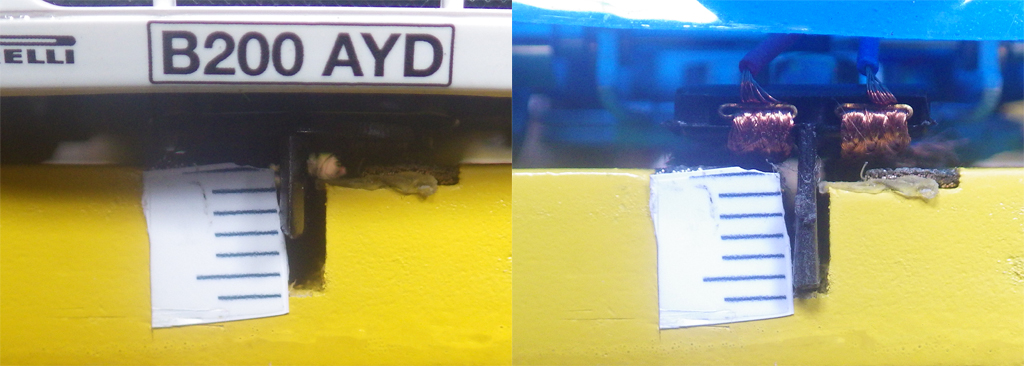
This car comes with a fairly hefty guide blade to keep it in the slot - it is after all I believe aimed at beginners. You may want to trim this down or even swap out for a more regular size guide. Standard slat car guide on left compared with the one provided.
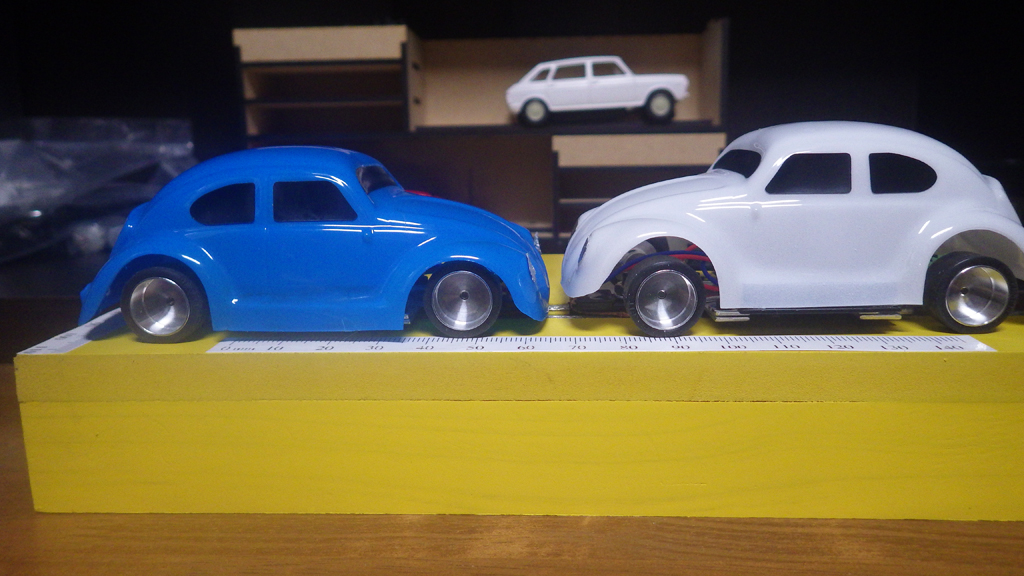
The cars themselves race pretty good out of the box and make a nice durable little car for younger racers. Just a personal preference, they come mounted quite high for the body, and I just rather see them sitting a little lower. The white car below sitting at the out of the box height, blue car is after moving the mounting plates.
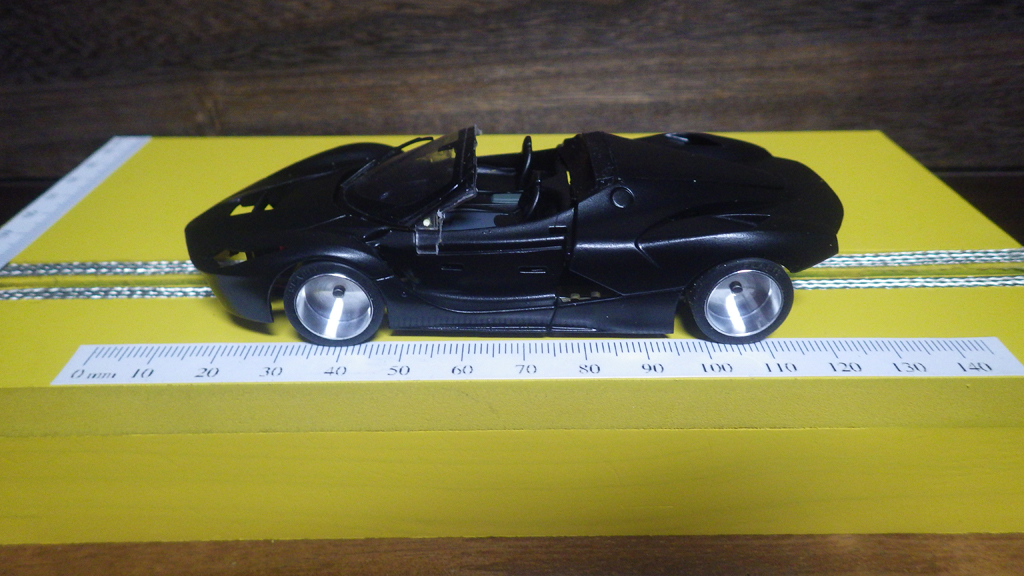
These sell for under $30 and so I think a really good deal to get a quality adjustable chassis for some project cars and kit bashing. Recycled a broken LaFerrari into a convertible and used one of these chassis for this.
If for some reason the content does no display properly here, you can see the original posting on my blog.
https://dazee-projects.blogspot.com/2019...-cars.html

A long time ago in a galaxy far, far away an 11 year old boy called Max Winter was parked at a commercial slot car raceway at the bottom end of Hamlet Court Rd in Westcliff-on-Sea by his grandmother while she went off to do the shopping. It was centred around 1/24th scale subjects as it was nearly all imported from the US. The seeds of a lifelong interest were sown and, as a result, his first slot car was a McLaren M6 Can-Am contender, liveried as driven by Denny Hulme.
Sometime later, now in his early 30’s Max stumbled upon a model car shop near his office called St Martins Accessories and, with a bit of disposable income to splash out, he spied the self-same McLaren that had spurred his interest in Motorsports some 20 years previously. It was a 1/43 white metal kit made by John Simmons of Marsh Models. The shop owner plonked it in his hand and its detail, finish and fidelity to the original was like nothing he’d seen before. He was smitten, a new hobby had been found. Soon after this, an article in Supercar Classics in 89 brought in slot cars to add to the static model habit.
The original concept for what later became a “Maxi-Model” first came about in the late 80s. Max Loved the old Scalextric/Exin stuff but wanted something better than the then current mainstream offerings that could approach the standards of the artisan produced 1/43rd scale models that he built and bought ready-made. He found the one 1/32nd scale resin multimedia kit available, a Michel Conte Ferrari F40 and set about converting it. It worked, after a fashion, but the full time job meant it remained just an idea and sat on a shelf. Then in the mid’ ‘90’s along came Fly, Ninco and the Spanish resin makers Slot Classic and Top Slot. Between them they really upped the game quite a bit and while all were excellent in their own right it was still not quite there yet to his eyes.
So, In 2000 Max decided to go into business as a small scale manufacturer trading under the name of Maxi-Models and marketing niche slot cars. That is to say, high quality slot cars based on race cars that might otherwise have been overlooked by the mainstream volume producing manufacturers. By now he had a large collection of both slot cars and static handmade miniatures from which to draw inspiration and he wanted to make something a bit more special than was on the market at the time. The cars would be accurate race/driver specific scale models while still having reasonable performance as slot cars.
Except for proprietary components such as the motor, gears and guide blades he proposed to make everything in house. Over the next few months Max tapped into the creativity of a group of talented craftsmen, including two of Britain’s top model pattern-makers, to ensure the success of this new venture.
Major contributors to the project included:
John Shinton – made the masters for all models except the Ferrari 612P.
Chris Sargent - made the masters for the Ferrari 612P. He also made most of the masters for Marsh Models.
Dave Buttress/CMA Moldform – Resin mouldings, metal castings and vac forms.
PEC – Photo etched parts.
Professor Motor - 26,000 rpm Mabuchi 'S' cans which replaced the original Scalex’ 'S' cans.
K&R Replicas – Tyres.
John Simmons/Marsh Models – helped with a lot of information on car specifications and build advice.
Spot-On Decals - They produce full size replica liveries for historic racers too.
Milton Keynes Paints who came up with all the matches for the cars.
Adrian Norman of Hornby Hobbies hosted the website and sales facility.
Having purchased a cottage which was formerly an antique shop he converted the shop part into the production centre, complete with a 65ft scenic track and set to work.
The first model was ready by July 2001 being the McLaren M6A #5 Denny Hulme 1967 Laguna Seca or #4 Bruce McLaren 1967 Laguna Seca, catalogue #MX-001. This was the very same car that had sparked his interest in motorsport, slot cars and modelling all those years previously.
The fully built RTR model was complete with a diorama base and CD-ROM V8 soundtrack at the then hefty retail price of £199 but to cater for smaller wallets it was also available as a prepainted kit at a lower price level of £99. The kit included the polyurethane resin body ready painted and finished, chassis, white metal castings, turned aluminium wheels, etched stainless steel detail components, vac-formed tinted screen, synthetic rubber tyres, Mabuchi motor, water-slide decals and a fully illustrated instruction sheet. Two heads with different helmets and choice of race numbers allowed you to build it as either Bruce or Denny. An unpainted kit was also available at £65 for the more experienced modellers who liked to paint their own.
It was a limited edition of 300 with hand written certificate and available through the specialist retailers who were most supportive of the venture – MRE, Scale Models, Pendle Slot Racing and Professor Motor.
It received rave reviews in the press and sold out in a fairly short space of time. Gary Cannell of MRE maintained it was probably the finest detailed slot car he had ever seen, better than a lot of collectors’ resin models but fully working and raceable. Encouraged by this initial success Max continued to produce further models over the ensuing couple of years and the range eventually included Lola T160, Ferrari 612P and a Ford GTP J car. All were available as fully built models, painted or unpainted full kits. A number of short run reliveries of the M6 variants were also produced with alterations to the masters by Max where necessary.
Built models and kits were initially supplied in made to order white “postal” cardboard boxes with coloured labeling showing front and side views of built up models with a separate printed L/E certificate. Later kits came in MRRC or Scalextric crystal display type boxes with a similarly printed sleeve that sometimes included the certificate printed on it rather than as a separate item. Most of the built models were supplied with their own ‘race specific’ diorama base and cover. An entry level, basic ‘Super Sport’ body kit which required a donor chassis was available for all models except MX001 and there was also a very limited run of ‘Sprint’ kits for some of the M6 variants with a lightweight body and full racing chassis.
Peter Novani’s comprehensive review of the first model by can be found in the NSCC magazine archives December 2001 issue, page 13 of the pdf and John Dilworth’s review of the later Lola T160 is in the October 2002 edition, page 23 of the pdf.
In 2004, although the models were reasonably successful and profitable, Max decided that overall demand wasn't sufficient to provide a viable long term source of income so he returned to a ‘proper’ job and wound down production. All the remaining stock was eventually bought by Phil Smith (scaleslotcars.com) who has one built model and three full kits available at the time of writing. He also has a stock of the spares, decals, chassis and bodies but these are not listed on his website so anybody interested in them would need to contact him direct.
Another ‘lost’ manufacturer then but Max’s cars were absolutely top notch and very few ever surface in the collectors’ market these days. As fairly heavy resin bodied items they obviously don’t stand comparison with today’s speed oriented makes such as NSR but they were very acceptable home racers and the attention to detail was way superior to anything else on the market at the time.
MX 001 M6A #5 Denny Hulme 1967 Laguna Seca/#4 Bruce McLaren 1967 Laguna Seca
Total production 300, approx. 1/3rd as built model, the rest kits. Decals for both versions were included. Three pre-production prototypes of this model also exist.
All built models are the Denny Hulme version apart from just one Bruce McLaren #4 Laguna Seca car with the larger rear brake ducts, which is owned by the man who did the artwork for the build instructions. It is certified 1/300 in the series.
MX 004A M6B Jo Bonnier #9 1968 Bridgehampton
Built 5 Kit 80
MX 004B M6B #99 Moises Solana
Built 6 Kit 13
MX 004C M6B #11 Lothar Motschenbacher
Built 8 Kit 8
MX 004D M6B #17 Jerry Titus
Built 7 Kit 5
MX 004E M6B #55 Rodger McCaig
Built 4 Kit 4
MX 004F M6B Richard Brown '69 #28
Built 5 Kit 7
004G M6B #54 Oscar Kovaleski
Built 4 Kit 7
MX 004H M6B Jay Hills' '71, #81
Built 3 Kit 5
MX 004J M6B #9 Jo Bonnier Riverside
Built 4 Kit 1
MX010 M6 #4 Bruce McLaren
Built 16 Kit 36. Modified body master.
MX 011A M6B "McLeagle" Dan Gurney #48 Bridgehampton
MX 011B M6B "McLeagle" Swede Savage #36 Laguna Seca
Built 30 Kit 39
MX 002 Lola T160TS John Surtees #7 1968 Riverside
Built 82 Kit 161
Aerofoil struts were pewter; they would bend but not snap like white metal would in a flip over.
MX 005A Lola T160 Dan Gurney Can-Am 1968, #48
MX 005B Lola T160 Swede Savage Can-Am 1968, #36
Built 21 Kit 35
A completely separate body master from MX002, not just a livery change.
Built 5 Kit 73
MX015 Ferrari 612P
Built 5 Kit 47
A different body master to MX008
MX 019 GTP 'J' car Le Mans test weekend 1966 McLaren/Amon.
Built 50 Kit 98
MX 001B Santa
A one off promotional model with its own snow scene diorama base with Xmas tree! Inscribed around the cockpit are all 8 reindeer names – hence R8 power and shod by “Goodeer”. It has a red nose but does not light up.
MX 006 M6 1967 High wing test car.
Prototype only, never released.
MX020 M6B #6 Mark Donohue Sunoco M6B Penske
Not released. Body and chassis master only were produced.
2 car sets on special diorama bases with covers.
MXD 001
1 Built
MXD 007
1 Built
MXD 014
1 Built
And Finally…………….
My thanks to Max Winter for his invaluable help in compiling this article, all photos were provided from his files and remain his copyright.
By the way, the masters are still in Max’s possession, including those for a couple of unreleased cars. If any budding entrepreneur would like to buy a turnkey project with support material and resurrect the range then I will happily put you in touch with him.

Hi Guys,
If you race Arc Pro or C7042 systems this maybe of interest to you?
Rick
SSD compatible lane changer electronics
SSD compatible chip

Three lane routed track, 70' in length
The wait is over - the new Pioneer Legends Racers are here!
The Pioneer Legends are based on 1934 Ford Coupe Hot Rods in a style that is raced around the world in Legends racing series. The real-life cars are 5/8 scale reproductions and the Pioneer cars work out around 1/30 scale. Whatever... they look fabulous and promise to be enormous fun on track.
The first two releases are:
PO63 Pioneer Legends Racer '34 Ford Coupe Blue #22
PO81 Pioneer Legends Racer '34 Ford Coupe Pearl White #30
Both are available to buy now at Inaslot, priced £41.95. The cars will be with other dealers very soon and can be pre-ordered. You can view more pictures here: www.inaslot.com/latest-releases
The Pioneer Legends models feature:
- 18K Typhoon motor, sidewinder configuration
- Detailed Race interior
- QuickChange braids
- Scalextric Digital DPR ready
- ‘PurePower’ wiring loom
- ‘Supathane’ tyres
- Display case and custom artwork packaging.
- Spare parts bag included under base.
The first Slot.it Mercedes 190E Classic DTM car has arrived in the UK! It is a much anticipated new model that I first saw as a prototype at the UK Slot Car Festival in 2018. The 190E will fit in perfectly alongside the Alfa Romeo 155 and Opel Calibra on the Classic DTM / Saloon grid...
Slot.it CA44a Mercedes 190E 2.5-16 Evo II DTM 1992 - Zolder #18 Kurt Thiim
Although a major force in the DTM series for a decade from the mid 1980s, the Mercedes 190E started out as a Cosworth-developed rally car. The arrival of the Audi Quattro ended the rallying project, but Mercedes went ahead with the planned 2.3 litre 16-valve road car that was required for homologation and began looking at Group A saloon car racing. Successful from the start in DTM, the road car was updated as the Evo in 1989 with the engine increased to 2.5-litres and with a host of mechanical and bodywork modifications.
The Evo II arrived the following year - even more aggressive, with massive wheelarches, a huge adjustable rear wing, a prominent front splitter and a rear window cowl. The engine was much the same 2.5-litre unit as in the first Evo, but with more power - now 235bhp. The basis of the Evo and Evo II engines allowed the final race cars to have between 330bhp and 350bhp.
The race version of the 190E Evo II first appeared midway through the 1990 DTM season, the works AMG-Mercedes cars driven by Kurt Tiim and Klaus Ludwig. In 1991, the likes of Jacques Laffite, Michael Schumacher, Hans Stuck and Bernd Schneider would run privately-entered Evo IIs. For the start of 1992 Schneider moved to the works AMG team and Kurt Tiim went to Zakspeed with whom he won the opening two rounds of the championship at Zolder in the #18 car produced here by Slot.it. Tiim would finish runner-up to AMG driver Klaud Ludwig at the end of the season.
Here's the car in action at Zolder...
Looking back through the archives, there are some fabulous 190E Evo II liveries for Slot.it to produce. It will be interesting to see how the 190E compares on track to its Alfa Romeo and Opel Calibra counterparts. Here are some comparisons of dimensions:
- Wheelbase: 83mm (Calibra: 80.5mm / Alfa: 79mm)
- Rear Track: 60mm (Calibra: 58mm / Alfa: 59mm)
- Height: 42mm (Calibra: 38mm / Alfa: 43mm)
- Weight: 70g (Calibra: 68g / Alfa: 68g)
I have absolutely no experience in this area (have never even driven a brass-chassis slot car) so would like to find out what are the benefits , if any, of brass chassis vs plastic chassis types, running mag-less on Scalextric Sport track.